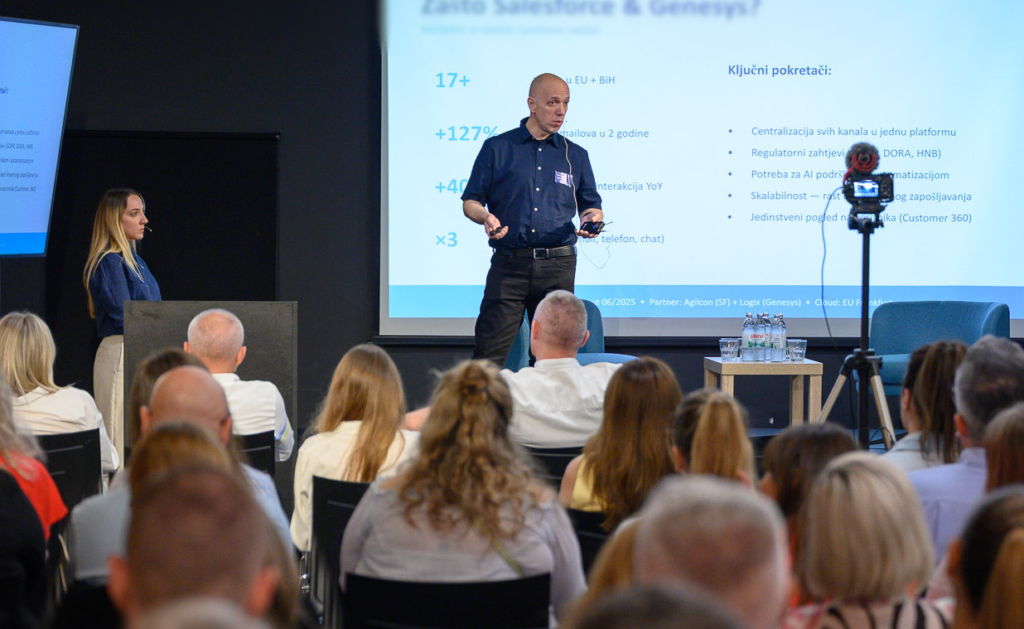
Customer emails at Aircash increased by 127% in two years, while total customer interactions continue to grow by around 40% year over year.
One contact centre team in Croatia supports customers across 17+ markets, more than seven languages and multiple digital channels. To keep pace, Aircash needed a service model that could handle rising demand without depending only on proportional team growth.
Together with Agilcon, fintech company connected its customer service processes, reduced repetitive work, and began applying AI to specific tasks where it could improve speed, multilingual support, and operational control.
The challenge: Every new market increased service complexity
Aircash provides digital wallet and payment services across Europe and Bosnia and Herzegovina. With no physical branches where users can resolve issues, customer requests reach the company through digital service channels.
These requests often include sensitive financial information, market-specific services or regulated processes. They arrive in different languages, through different contact addresses and sometimes through the wrong channel.
As volumes grew, Aircash faced four main operational challenges:
- Repeated messages created duplicate cases and unnecessary work.
- Agents needed faster access to customer history and open requests.
- Supporting more than seven languages complicated recruitment and routing.
- Complaints and unauthorised transactions had to be recognised and handled within strict deadlines.
Aircash needed better agent context, less administration and controlled automation for sensitive processes.
What we built: A connected, AI-ready service operation
Aircash introduced a connected service environment bringing together customer information, emails, calls, open requests, complaints and internal escalations.
Agents can now see previous interactions, related cases and current ownership in one place. Requests are routed more consistently, while deadlines and alerts support time-sensitive complaint processes.
This foundation provides the processes, data and knowledge needed to introduce AI gradually and safely.
1. Less duplicate work and better agent context
When customer sent several separate emails about the same issue, each message could create a new case. Different agents could then start working on the same problem without knowing it was already being handled.
Agents can now see other open requests from the same customer, identify duplicates and close related cases together.
Duplicate-case handling is significantly faster, with less manual administration, cleaner queues and more agent time available for requests that genuinely require attention.
2. More scalable multilingual service
Aircash uses AI to recognise the language of written requests automatically. This supports faster routing and removes the need for agents to identify the language manually.
Agents can also translate incoming messages and prepare responses within the protected service environment. Sensitive customer information does not need to be copied into public translation tools or external AI applications.
Aircash can therefore support customers across more languages while maintaining control over customer data and final responses.
3. Faster categorisation with human control
AI suggests categories for incoming written requests, reducing the administration required for each case. Agents verify and correct the suggestions, helping the system improve over time.
The capability is already in production and currently reaches an estimated accuracy of 50–60%. Aircash is working towards approximately 80% accuracy as more context and agent feedback become available.
The same controlled approach applies to complaints and unauthorised transactions. AI helps identify and route potential critical cases, especially when they arrive through a general contact address.
Agents continue to verify these requests because missing a regulated case or strict deadline would create significant customer and compliance risk. Human oversight remains part of the operating model.
4. Trusted knowledge for agents and AI
Operating across different countries, languages, currencies and services meant a traditional knowledge base could have required up to 2,000 separate articles.
Instead, Aircash consolidated public and internal information into a structured knowledge source organised by market, language and topic.
Agents can use this approved content to generate suggested answers based on the customer’s request. The same foundation will support Archie, Aircash’s planned in-app AI assistant, which will answer common questions and transfer customers to a live agent when needed.
A good knowledge source is essential. Without reliable knowledge, AI cannot provide reliable answers. Clear instructions, ongoing monitoring and continuous improvement are just as important.
Ivana Holjevac Brdar
Solution Consultant, Agilcon
The impact: Less repetitive work and greater control
Aircash has reduced repetitive work, improved agent visibility and introduced stronger control across multilingual and regulated service processes.
The main improvements include:
- Significantly faster duplicate-case handling
- Faster and safer multilingual support
- Less manual categorisation and clearer reporting
- Stronger control over complaints and time-sensitive requests
Agents have better context and spend less time on repetitive administration. Service leaders gain clearer visibility into customer demand, while critical decisions remain under human control.
We decided to start from the ground up, build a system we could develop step by step and apply AI where it can bring real value, supporting the company’s growth while maintaining the level of quality we strive for.
Alan Sredić,
Contact Centre Expert, Aircash
Building towards 30–50% more interactions with the same team
Aircash is expanding AI use case by use case, starting Archie in smaller markets so the team can test answer quality before wider rollout. The company is targeting a 30–40% chatbot deflection rate.
Combined with better routing, suggested responses and reduced administration, these capabilities support Aircash’s goal of enabling the same contact centre team to handle 30–50% more interactions.
Both figures are future targets that will be measured as the capabilities mature.
Aircash now has a customer service operation designed to support continued growth without allowing operational complexity to increase at the same pace.
Is your customer service operation ready to scale?
Connect customer information, service processes and knowledge so your teams can resolve requests faster and introduce AI with greater control.
Talk to Agilcon about building a service operation that can support more customers, markets and interactions without proportional growth in complexity.

Talk to our team
Book a free consultation and see how we can help you reach your goals.