


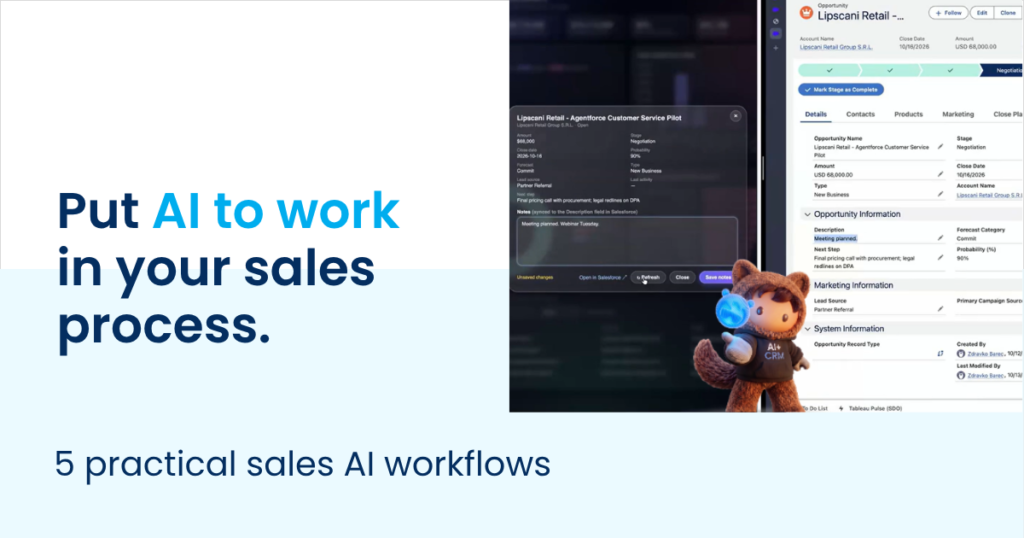
5 practical workflows that bring AI into everyday sales work.
One of your salespeople has an upcoming customer meeting. They ask an AI agent in their team’s chat tool, such as Slack or Microsoft Teams: “Bring me up to speed on this account.”
With the right connections, the agent can pull together the account history, recent conversations and open opportunities. The salesperson gets a concise brief in the tool they already use, without having to gather the information themselves.
It’s time software did more of the work.
In a Salesforce-based setup, customer data, business rules and permissions provide the foundation. With approved integrations configured for the workflow, an agent can use relevant customer information in tools such as Slack, ChatGPT or Claude.
Clear rules define what the agent can access, which actions it can take and when a person needs to approve the next step.
5 sales AI workflows to consider
Compare the implementation effort and what each workflow could give your team.
| Sales AI workflow | Implementation effort | What the salesperson gets |
|---|---|---|
| Meeting preparation | Reliable CRM records, account history and meeting notes | An account brief with recent conversations, open opportunities and suggested discovery questions. |
| Prospecting | ICP, CRM data and approved business sources | A prioritised target list and personalised outreach drafts. |
| Lead qualification | Qualification criteria, offering details and reliable prospect information | A fit assessment showing how the prospect’s needs match your offering and what still needs to be confirmed. |
| Proposals & documentation | Templates, current product and pricing data, and review rules | Proposal and sales document drafts with relevant product details, pricing and approved wording. |
| Cross-sell & upsell | CRM data and product information | Suggested additional products or upgrades for existing accounts, with reasons to explore each opportunity. |
Effort ratings are indicative and depend on your existing systems, data and required approvals.
- Meeting preparation: Bring account history, previous conversations and qualification findings together before a call. Use the brief to spot gaps and prepare questions.
- Prospecting: The agent researches companies against your ICP and drafts personalised first messages. The salesperson reviews the suggested targets and outreach before making contact.
- Lead qualification: This can follow prospecting: the agent researches the prospect’s situation, compares stated needs with your offering and flags questions for the next sales meeting.
- Proposals & documentation: Start with a draft assembled from your templates, product details and pricing rules. Check the content and commercial terms before sending.
- Cross-sell & upsell: Identify products or upgrades that may suit an existing customer, then check whether there is a current need worth discussing.
Give agents the context they need
A meeting brief may only need reliable CRM records and notes. A proposal may also need current prices from ERP, while a cross-sell suggestion may need information about an unresolved service issue.
Connect the information your chosen workflow needs, and agree which source the agent should use when records disagree. Fix the gaps that affect the task, then expand from there.
Choose one workflow and test its value
If complex proposals take your team hours to prepare every week, document drafting may be worth exploring. If researching target accounts keeps delaying outreach, prospecting support may have more value.
Choose one recurring problem and assess it with these six questions:
- Frequency: Does it happen often enough to matter?
- Friction: Where does the team lose time or customer context?
- Clarity: Can you define a useful output or next step?
- Data: Is the required information available and trustworthy?
- Control: What can AI do independently, and what needs approval?
- Impact: How will you measure improvement?
Measure the complete workflow, including salesperson review. For proposals, track preparation time and how much rewriting is needed. For qualification, track the proportion of recommended prospects your sales team accepts as a good fit.
Compare the results with how your team handles the task today, then weigh the improvement against implementation and ongoing costs.
Before testing live actions, agree which decisions need salesperson approval and address gaps in the information those actions require.
Build on the workflows that deliver value
Once a workflow proves useful, decide what the results justify next. That might mean extending it to more salespeople, connecting additional information or allowing the agent to handle more steps.
At Agilcon, we help companies identify valuable sales workflows and build the CRM, data connections and processes needed to make them work.

Talk to our team
Book a free consultation to identify a practical AI workflow for your sales team.


