You already know when your customer shops, what they buy and how much they spend. So why does the communication still fail to follow their behaviour?
Retailers often know far more about customer behaviour than they act on.
About every three weeks, the same pattern appears: a store visit, a purchase of around €80 and another transaction added to the loyalty profile. A coupon arrives, but with no clear link to what the customer usually buys or what they may need next.
Technically, the loyalty programme worked. It recorded the purchase, updated the points balance and delivered an offer.
But it failed to turn a clear behavioural pattern into a more relevant next interaction. Repeated missed moments make customers feel unrecognised.
This is the paradox many retailers face today. They have more loyalty members, more data and more campaign possibilities than ever, but too many valuable moments still go unused.
Programmes still reward transactions instead of strengthening customer relationships. So what are you investing in: loyalty or discounts?
When every interaction starts with a discount, loyalty quickly becomes margin loss.
Customers changed. Have loyalty programmes kept up?
Shoppers can compare prices, switch retailers and find alternatives in seconds. At the same time, global players have raised expectations for fast, simple and personalised digital experiences.
Competition is no longer a few streets away. It is a few taps away.
Customers expect benefits that reflect their needs, habits and timing. They want retailers to recognise them across channels and use the data they share to make each experience more relevant.
If it makes little difference whether someone shops once a month or three times a week, buys children’s products or power tools, or prefers a physical store, an online shop or a mobile app, the programme recognises the membership number.
It does not recognise the customer.
What a strong loyalty strategy requires
A strong loyalty strategy connects behaviour, timing and customer value to the next best action.
That starts with connected data. Store visits, ecommerce activity, mobile engagement, marketing responses and service interactions need to tell one consistent customer story.
With that context, retailers can spot declining engagement, recognise high-value customers, personalise rewards and act before a valuable moment passes.
Marketing, ecommerce, service and store teams can then work from the same insight instead of sending disconnected messages.
The result is loyalty that improves retention, grows customer value and makes its commercial impact visible.

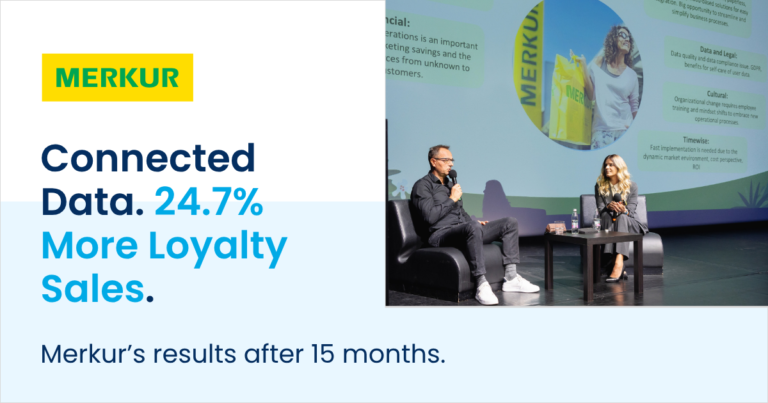
How Merkur increased loyalty sales by 24.7%
Merkur connected loyalty activity, purchasing behaviour and customer interactions across channels, giving its teams a live view of every customer.
Marketing, sales and store teams could finally work from the same insight, personalise communication and rewards, and adjust loyalty activity in real time.
The programme combines customer statuses, cashback, coupons and advanced segmentation.
For example, when a customer starts to disengage, Merkur changes the conversation. A move into a hibernating or at-risk segment can trigger a different coupon or incentive. The team then tracks the response and adjusts the offer quickly if it underperforms.
What the customer receives, and when they receive it, changes with their behaviour.
Within 15 months:
- loyalty sales increased by 24.7%
- average basket value increased by 16.4%
- the number of active members increased by 25%
- the programme grew to more than 350,000 loyalty members who shop at least once a year
We came to Agilcon with a vision and expectations. They guided us through a transformation and helped us translate that vision into a scalable, business-driven solution with a clear roadmap for the future.
Robert Petrič
Director of CRM, Analytics and Loyalty, Merkur
Connected technology closes the gap between insight and action. Salesforce brings loyalty, CRM, marketing, e-commerce, and service data into one customer context, while AI helps identify changing behaviour and recommend the next best action.
Read the entire Merkur story here.
Turn customer data into stronger loyalty
Ask these three questions:
- Do teams work from one reliable customer view?
- Can customer behaviour trigger the right action at the right moment?
- Do you measure active engagement, retention and incremental revenue, or mainly members and points?
The answers reveal whether your loyalty programme can consistently turn customer behaviour into the next relevant action and where valuable customer signals are still going unused.
Together, we can turn those signals into more relevant communication, stronger engagement and measurable growth.

Talk to our team
Book a free consultation and see how we can help you reach your goals.